

Liturgical Items
Click here for a detailed description of the Church in our Commemorative Dedication Journal.
Marble
The Altar of the Twelve Apostles, the Ambo, the Baptismal Font, the Tabernacle House and stand, the Ambry stand, the Holy Water Font and the statutes of Mary and the saints were specially designed for our Church by Vitreartus Liturgical Arts Division, a Philippines company specializing in custom religious art. Each of the Altar, Ambo, Baptismal Font, Tabernacle House and stand, Ambry stand, and Holy Water Font were sketched and then carved from marble while the figures of Mary and Joseph on either side of the main Sanctuary (as well as the figure of Mary, a crucifix and Saints John, Therese, Francis and Anthony in the outdoor Meditation Garden) were carved from clay before they were sculpted from the marble. The Altar weighs over 7,700 pounds, the Ambo over 3,300 pounds, the Baptismal Font over 4,000 pounds, the Tabernacle stand over 2,200 pounds, and each of the statues of Mary and Joseph over 1,100 pounds. All of the marble for these items was quarried in the Philippines.
Altar of the Twelve Apostles
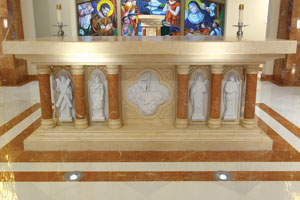 The Altar is the locus of the sacramental presence of Christ Himself in the midst of the assembly of His faithful. The Altar is the place where the two aspects of the same mystery conjoin: the altar of the sacrifice because Christ suffered, died, was buried and rose from the dead for our salvation and because the sacrifices of the martyrs are joined with Christ’s sacrifice; and the table of the Lord because we share in the Lord’s Supper through the transubstantiation of the bread and wine into the Body and Blood of Christ. The Altar is accorded the honor due a symbol of Christ’s presence — it is kissed at the beginning of Mass and it may be honored several times with incense during services. Even when the sacrament is not present on the Altar, we may honor the Altar with a deep bow.
Five crosses are carved on the top of the Altar, the image of the Lamb of God is carved on the center front, the coat of arms of St. Pius X is carved on the center back and each of the twelve Apostles is carved around the Altar with a symbol relating to his life or martyrdom. The tabletop is one solid piece and the relief portions are cut into four sections.
The five crosses carved into the top of the Altar, one in each corner and the fifth in the center rear, memorialize the consecration of the Altar. During the consecration of the Altar, His Eminence Timothy Cardinal Dolan anointed the five crosses.
The image of the Lamb of God (known as the Agnus Dei) reminds us that Jesus is the true Passover Lamb who shed his blood and died on the cross as God’s perfect and ultimate sacrifice to save us from sin and death and rose again from the dead three days later so that we could have eternal life. Specifically, the lamb standing with the banner symbolizes Christ’s victory over death in the Resurrection.
The coat of arms of St. Pius X is carved on the Altar in honor of our Church’s patron saint. A relic of St. Rita of Cascia and a relic of St. Pius X have been placed in a small square cavity or sepulchrum above his coat of arms.
The papal arms of St. Pius contain the elements of all popes before Pope Emeritus Benedict XVI, specifically a shield, the papal tiara and the keys. (The Holy Father Emeritus Benedict XVI decided not to include the tiara in his official personal coat of arms. He replaced it with a simple mitre.) The tiara and the keys symbolize the authority of the pope. In Chapter 16, verse 19 of Matthew’s gospel, Christ told Peter:
“I will give you the keys to the kingdom of heaven. Whatever you bind on earth shall be bound in heaven; and whatever you loose on earth shall be loosed in heaven.”
The top part of the shield represents the arms of the Patriarch of Venice consisting of the lion of St. Mark with a book bearing the inscriptions: Pax Tibi Marce on the left page and Evangelista Meus on the right page. Pax tibi Marce Evangelista Meus is the motto of Venice and is Latin for “Peace to you, Mark, my evangelist.” The anchor in a stormy sea lit up by a single six-pointed-star represents the arms used by St. Pius X as Bishop of Mantua.
The image of the twelve Apostles reminds us that the Altar is the table of the Lord and that Catholics are called together to share in the Lord’s Supper during Mass. Jesus Christ chose the twelve Apostles as the first disciples to follow Him and by extension we, too, have been chosen by Christ to follow Him. The Apostles started the process from an established ecclesial perspective, and we are a continuation of that same process and calling to be a child of God.
Each Apostle carved into the Altar is holding a symbol relating to his life and/or an instrument of his martyrdom in which he gave ultimate witness to his love of Christ and the Holy Church.
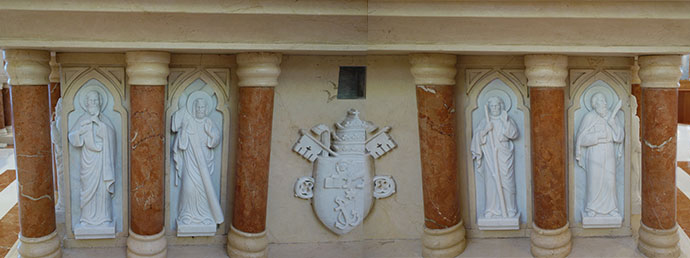
Andrew is depicted with an x-shaped cross or saltire to signify that he was crucified.
Bartholomew is depicted with a knife to show that he was flayed alive and a Bible to symbolize that he carried a copy of Matthew’s Gospel.
James the Great is depicted with a bag full of shells, a pilgrim’s staff and a purse to symbolize his missionary journeys.
James the Less is depicted with a pilgrim’s staff to represent his missionary journeys.
John is depicted with a pen and a scroll because he was an evangelist.
Jude is depicted with an axe and a palm frond to symbolize that he was hacked or clubbed to death and with the Holy Mandylion to his chest. (The Holy Mandylion contains an imprint of Jesus’ face because St. Jude brought a cloth bearing Jesus’ face to Abgar, the king of Edessa, and healed him.)
Matthew is depicted with a pen and a scroll because he was an evangelist.
Matthias is depicted with a stone to indicate that he was stoned to death.
Peter is depicted with a key to signify that Christ gave him the keys to the “Kingdom of Heaven” and a scroll to indicate that he was an evangelist.
Philip is depicted with a rope around a cross to show that he was bound to a cross and then stoned to death.
Simon is depicted with a saw to indicate that he was sawn in half.
Thomas is depicted with a spear/lance to signify that he was stabbed.
Ambo (also known as the Pulpit)
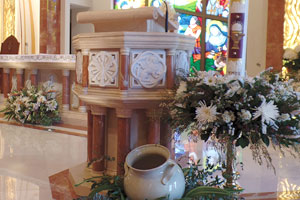 The Church teaches that at Mass the people of God are served from two tables: the table of the word (or the Ambo) and the table of the sacrament (or the Altar). The faithful receive Christ Himself, present in the Word proclaimed from the Ambo and in the bread and wine that become his Body and Blood at the Altar. In the same way that the Liturgy of the Word and the Liturgy of the Eucharist are closely related to make up one act of worship, the Altar of the Twelve Apostles and the Ambo are made from the same marble.
A dove, which represents the Holy Spirit, and the symbols of the four evangelists, who represent the Heart of the Scriptures—the Holy Gospels—or the principal sources of our Lord’s life, deeds, and teachings, are carved on the Ambo. In an ancient tradition that is based in Scripture (from the Books of Ezekiel and Revelation), the symbols of the Man, the Lion, the Ox, and the Eagle represent the Evangelists Matthew, Mark, Luke, and John, respectively.
Matthew is shown on the Ambo as the Winged Man because his Gospel begins with the human or manly genealogy of Christ (i.e., Christ’s Incarnation or conception in the womb of Mary through the Holy Spirit). Christ’s human nature reminds Christians that they should use their reason for salvation.
Mark is the Winged Lion because his Gospel begins with the roaring or preaching of John the Baptist in the desert. He represents Jesus’ Resurrection and Christ as king to remind Christians that they should be courageous on the path to salvation.
Luke is depicted as the Ox because his Gospel begins and ends in the Temple where oxen were sacrificed thereby recalling Jesus’ sacrifice in His Passion and Crucifixion as well as Christ’s position as High Priest. This teaches Christians that they must be ready to sacrifice themselves to follow Christ.
John is symbolized as the Eagle because his Gospel begins with the majestic prologue of the Word and soars and penetrates to heights that surpass the synoptic gospels (i.e., the gospels of Matthew, Mark and Luke). The eagle represents Jesus’ Ascension into heaven and divine nature and instructs Christians that they should look to eternity without fear as they journey towards union with God.
Baptismal Font
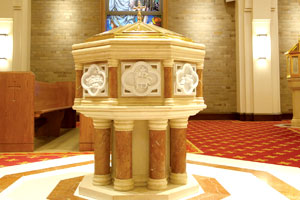 The placement of the Baptismal Font near the entrance to our Church serves the symbolic purpose of reminding us that Baptism is our birth into a new life in Christ, a birth that is necessary for our salvation. In Baptism, we are cleansed from original sin by the Blood of Christ and receive God’s Spirit. Placing the Baptismal Font near the entry reminds us of our initiation into the Church and that we are God’s baptized people.
The octagonal (or eight-sided) shape of our Baptismal Font represents the New Creation or Jesus’ rising from the dead “on the first day of the week.” The “first day of the week” or the day of Christ’s Resurrection recalls the first creation in which God created the world and rested on the seventh day or the Sabbath. The seventh day completed God’s first creation. The “first day of the week” after the seventh day or the Sabbath is the eighth day or the first day of the new creation ushered in by Jesus’ Resurrection.
The eight-sided gold plated cover topped by a cross is decorated with silver plated triangles to remind us of the triune God—the Father, the Son and the Holy Spirit.
The Baptismal Font carvings show events selected from salvation history to recall this New Creation. Below is a description of these events in the order shown on the Baptismal Font, not the sequence in which the events occurred, starting with the apple and snake:
• The snake wrapped around an apple recalls the fall of Adam and Eve and reminds us that the original sin of our first parents is washed away in our Baptism.
• The ram recalls that Abraham sacrificed a ram caught in a thicket by its horns after being commanded by an angel of the Lord not to harm his only son, Isaac. Abraham and his willingness to sacrifice his only son, Isaac, when commanded by God, herald the sacrificial death of God’s only son, Jesus, on the cross for our salvation so that we can receive the graces of Baptismal life.
• The Ark of the Covenant with the tablets containing the Ten Commandments given to Moses presage the new law to love God and to love one another as God loves us instituted by Christ and to which we agree to be bound through Baptism.
• The manger with the lamb underneath and the star recall our new birth in Jesus and into His Church through Baptism.
• The lamb with the banner recalls Christ’s victory over death in the Resurrection and reminds us that in the waters of Baptism, our old self dies and is buried and we are born to a new life with the hope of salvation.
• The hand holding the basket and seeds being thrown to the ground by the other hand recall the parable of the sowing of the seeds and remind us that if we choose to follow the new law promulgated by Christ, the Kingdom of Heaven will open to us through Baptism.
• The crown of thorns, scepter (or staff) and the cape recall Christ’s Passion/Crucifixion and cause us to remember that in Baptism we undergo a transformation: just as Christ died and rose from the dead, we, too, in Baptism die and rise from the dead symbolized by our immersion in and emersion from water. In Romans 6:3-4 we are told:
“Or are you unaware that we who were baptized into Christ Jesus were baptized into his death? We were indeed buried with him through baptism into death, so that, just as Christ was raised from the dead by the glory of the Father, we too might live in newness of life.”
• King David’s crown reminds us that in Baptism we are called to serve God. The office of the King of Israel was not just a man-made office; rather it was God’s office. When David was anointed king, the Spirit came upon him and he was charged with serving God. Similarly, in Baptism, we are admitted into the Church, receive God’s grace and are called to reign and serve God as King David did.
Tabernacle, Tabernacle House and Stand
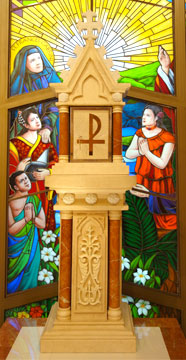 The Old Testament tells us that the Tabernacle was the portable dwelling place for the divine presence of God from the time of the exodus from Egypt through the conquering of the land of Canaan. Today, the Tabernacle is a box-like vessel reserved exclusively for the consecrated Eucharist for distribution at Masses and for readiness to bring Holy Communion to the infirm.
The Tabernacle is at the very center of our Sanctuary. It has been deliberately placed against the backdrop of the Ascension of Jesus Christ stained glass window where the children of the world and the saints are bowing in worship. The Tabernacle House was crafted from the same marble as the Altar of the Twelve Apostles, Ambo and Baptismal Font. The upper portion of the Tabernacle House itself has three small crosses on each side leading to a larger crucifix. The Tabernacle is constructed from stainless steel with a lock. It has a gold staurogram or a monogram-like combination of the Greek tau (T) superimposed on the Greek rho (P) on the front. The vertical stroke of the ‘P” is placed over the “T” so that the vertical loop of the “P” appears as the head of a crucified figure on a “T” shaped cross. The staurogram was first used to abbreviate the Greek word for cross or crucifix or as a symbol of the crucified Christ.
The marble stand to which the Tabernacle is bolted is carved with a decorative depiction of leaves, foliage and vines. This is a common motif in Church decorations reminding us that Jesus is the vine and His people are the branches. The profusion of leaves represents life and reminds us that so long as we, the branches, are without sin, we remain connected to Christ, the source of life and nourishment for our souls.
Statutes of Mary and Joseph
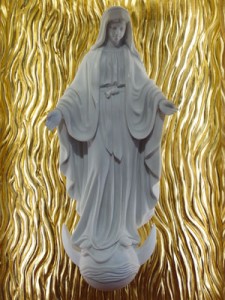 The marble life size statues of Mary and Joseph, against gold leaf wood panels carved to simulate flowing water, are centered on either side of the Sanctuary.
Mary is shown standing on a crescent moon with her foot crushing a serpent’s head. The moon, a symbol of fertility related to life and death in its three phases—dying (waning), generating (waxing) and giving birth (full moon), and the serpent, a symbol of the devil, remind us of Mary’s special role in the plan of salvation as the mother of the Son of God. As a descendant of Adam, Mary should have been subject to original sin, but because she was the new Eve, who was to be the mother of the new Adam, Jesus, she was conceived without sin in the Immaculate Conception through the eternal counsel of God; and she conceived Jesus through the Holy Spirit in the Incarnation. Chapter 3, verse 15 of Genesis, the first Scriptural passage that contains a promise of redemption, mentions the Mother of the Redeemer:
“I will put enmity between you and the woman, and between your offspring and hers; they will strike at your head, while you strike at their heel.”
Joseph is shown holding the infant Jesus to represent his role as the husband of Mary and the guardian of Jesus. The cross being held by the infant Jesus reminds us that He would suffer, die, 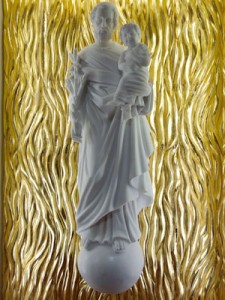 be buried and rise from the dead so that we could have eternal life. The lily branch signifies the beginning of the New Kingdom that flowed from Christ’s Resurrection from the dead.
Year at a Glance
View a calendar of events for the entire year.
Click here.
Participate
Become a member of the Church of Saint Pius X Family.
Click here.
Volunteer
Volunteer and help…
… during the liturgy.
… in the Church Community.
… in an outreach project.
Renovation
See how our church has changed, and continues to be improved.
Click here.